
Criminal Court Cases in Mecklenburg County
Mecklenburg General District Court is the first court for misdemeanors, traffic charges, and preliminary proceedings in felony matters. A felony entry in that court may show an advisement, hearing, or certification rather than the final felony result. After a felony is certified or indicted, the prosecution proceeds in Mecklenburg Circuit Court. The Circuit Court also hears appeals from district court, so a misdemeanor can appear there as an appeal. Court level therefore reflects procedure, not a simple split between minor and serious databases.
The clerks keep the official court files. General District Court is at 911 Madison Street in Boydton and publishes (434) 738-6260. Circuit Court is at 393 Washington Street, with criminal inquiries at (434) 738-6191, extension 4210. The online docket is a useful index, but a clerk is the source for pleadings, orders, certified copies, and older material not shown online. A sheriff report or regional booking entry is a separate record and cannot replace the court file.
Mecklenburg County Court Levels
The county's two court buildings sit close together in Boydton but answer different questions. The Mecklenburg General District Court page gives district contacts and the local docket pattern. It is the best clerk route for a misdemeanor judgment or the preliminary history of a felony. The Mecklenburg Circuit Court page covers felony files, district appeals, terms, and the rule that criminal matters must be preset with the Commonwealth's Attorney.
The official Circuit Court image below identifies the court that maintains indicted and certified felony cases. It also anchors the correct courthouse contact instead of sending a court-record request to county administration.
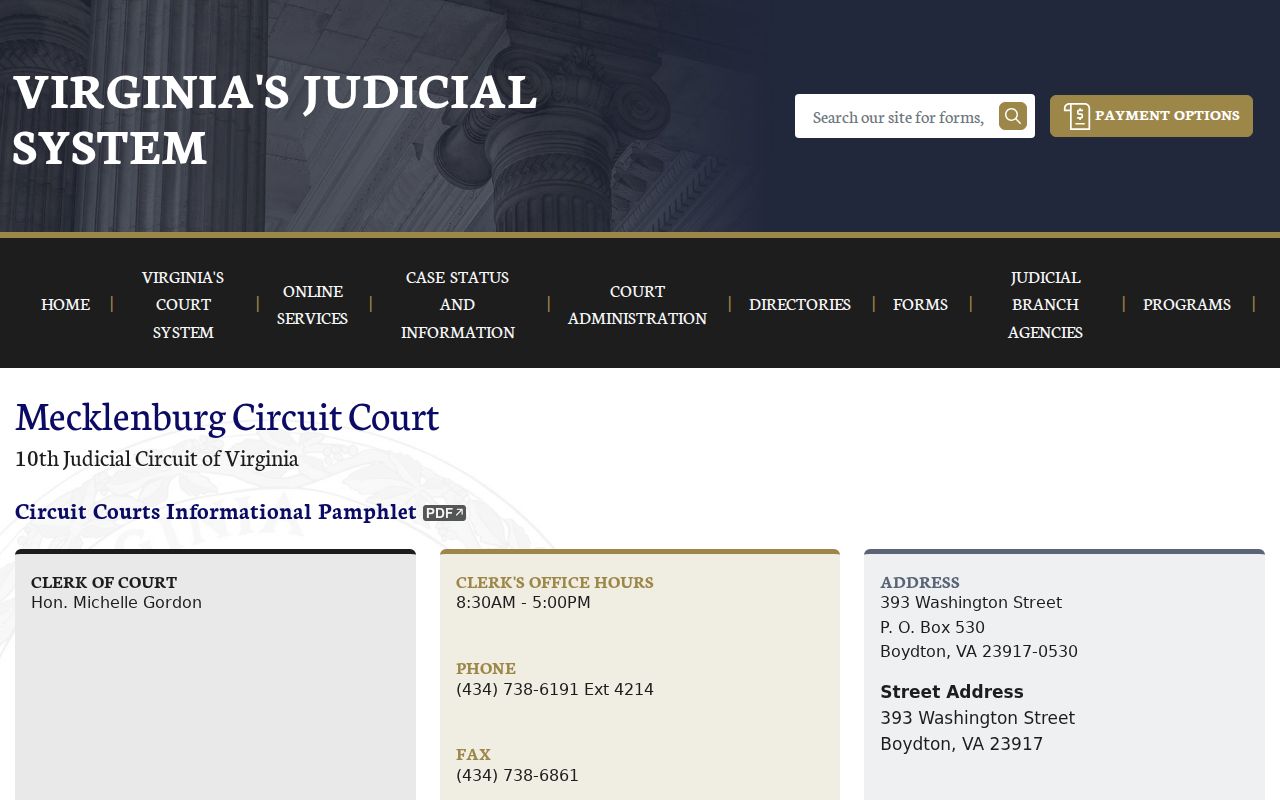
Use the Circuit clerk after an indictment, certification, appeal, or when the requested judgment belongs to that court.
Mecklenburg County Case Record Searches
Begin with the Virginia Judiciary Online Case Information System. Statewide search can help identify a locality, but the Judiciary does not promise one universal Circuit search that covers every circuit. Once Mecklenburg appears, move to the locality-specific Circuit or General District system. A known case number is the cleanest key. For a name search, use the spelling shown on the warrant or summons. Hearing-date search is useful for a known docket day.
- Open the official case-information hub and choose the statewide or locality route that fits the known facts.
- Select Mecklenburg Circuit or Mecklenburg General District Court based on the charge stage.
- Search by case number, party name, or hearing date, then compare court and charge details.
- Read each count's plea, judgment, disposition, sentence, and event history rather than relying on one status label.
- Ask the correct clerk for a pleading, order, certified copy, or older file that the online result does not provide.
| Field or Route | Type | Required | Use |
|---|---|---|---|
| Court or locality | Dropdown | Yes in locality search | Choose Mecklenburg Circuit or GDC |
| Name Search | Mode and text | One route | Last, First, Middle; match filed spelling |
| Case Number Search | Mode and text | One route | Most precise when the number is known |
| Hearing Date Search | Mode and date | One route | Finds a known docket day |
| Mark For Payment | Result control | No | Available only for eligible cases |
Note: Online payment eligibility does not mean that the complete Mecklenburg County criminal case file can be downloaded.
Mecklenburg County OCIS Search
The Virginia Judiciary case-search instructions explain how public users locate records and why juvenile cases are not available through the public systems. The official search image below shows the court-search choices that lead to Mecklenburg County court records.
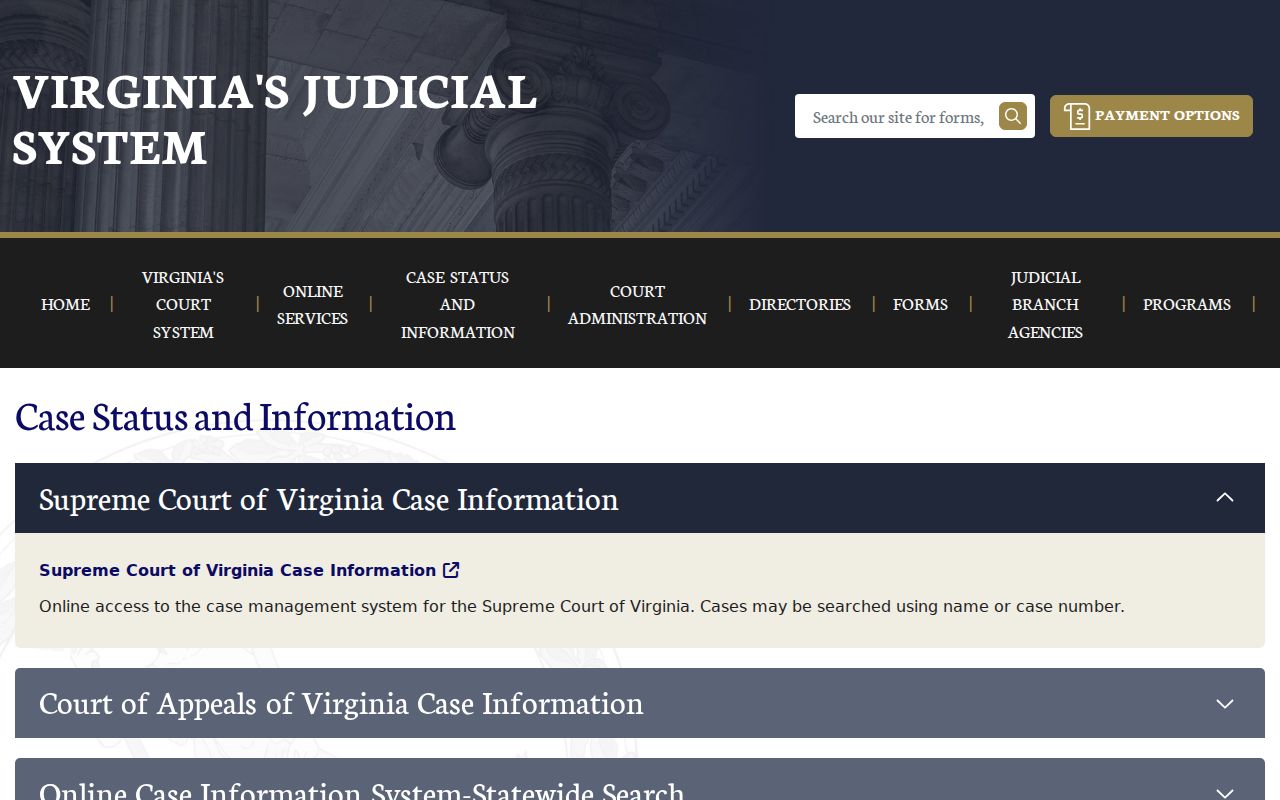
A search result can show the court, case number, displayed party, charge and statute, hearing information, case status, plea, disposition, judgment, sentence, fines, costs, and payment eligibility when those fields are populated. It is not a scanned case jacket. Date of birth is not ordinary public output, juvenile information is excluded, and sealed matters do not appear. If two people share a name, compare court, charge, dates, and agency without treating the result as a fingerprint match.
Payment controls need care. The Judiciary states that paying a prepayable charge before court follows a waiver and guilty-plea route. Payment must be made by the stated cutoff on the business day before trial, and post-court payment may not appear until the nightly update. Those facts describe the record system; they are not advice about how anyone should plead.
What a Criminal Case File Contains
A Mecklenburg County case file centers on what was filed and what the court did. The initial arrest charge may change after review by the prosecutor or grand jury. Each count can also end differently, so the disposition must be read at charge level. A docket is the schedule and event log. The pleading file may add the complaint, warrant, indictment, motions, orders, judgment, and other documents maintained by the clerk.
| Case Number and Court | Identifies the Mecklenburg court and the court's own file. |
|---|---|
| Charging Document | Shows the complaint, warrant, summons, or indictment that placed a charge before the court. |
| Docket Entries | List scheduled and recorded events, continuances, filings, and later activity. |
| Hearing Dates | Show planned settings; a date alone does not prove the hearing occurred. |
| Disposition and Judgment | Record the result for each charge, such as conviction, dismissal, acquittal, or nolle prosequi. |
| Sentence and Conditions | Describe the court's sentence, suspended terms, costs, fines, and related orders when applicable. |
The full case record gives more context than an arrest entry. For the custody event and initial booking charge, consult the county's arrest search routes.
Mecklenburg County Criminal Dockets
Mecklenburg County has a local calendar pattern worth checking before calling a clerk. General District Court groups town matters on Mondays, State Police cases on Tuesday, and county criminal and traffic matters on Thursday. That pattern can help a reader choose a hearing-date search and identify whether a town police department, a state trooper, or the Sheriff likely started the matter. It does not alter which clerk keeps the case.
The official General District Court image below comes from the court page that lists Mecklenburg contacts and docket details.
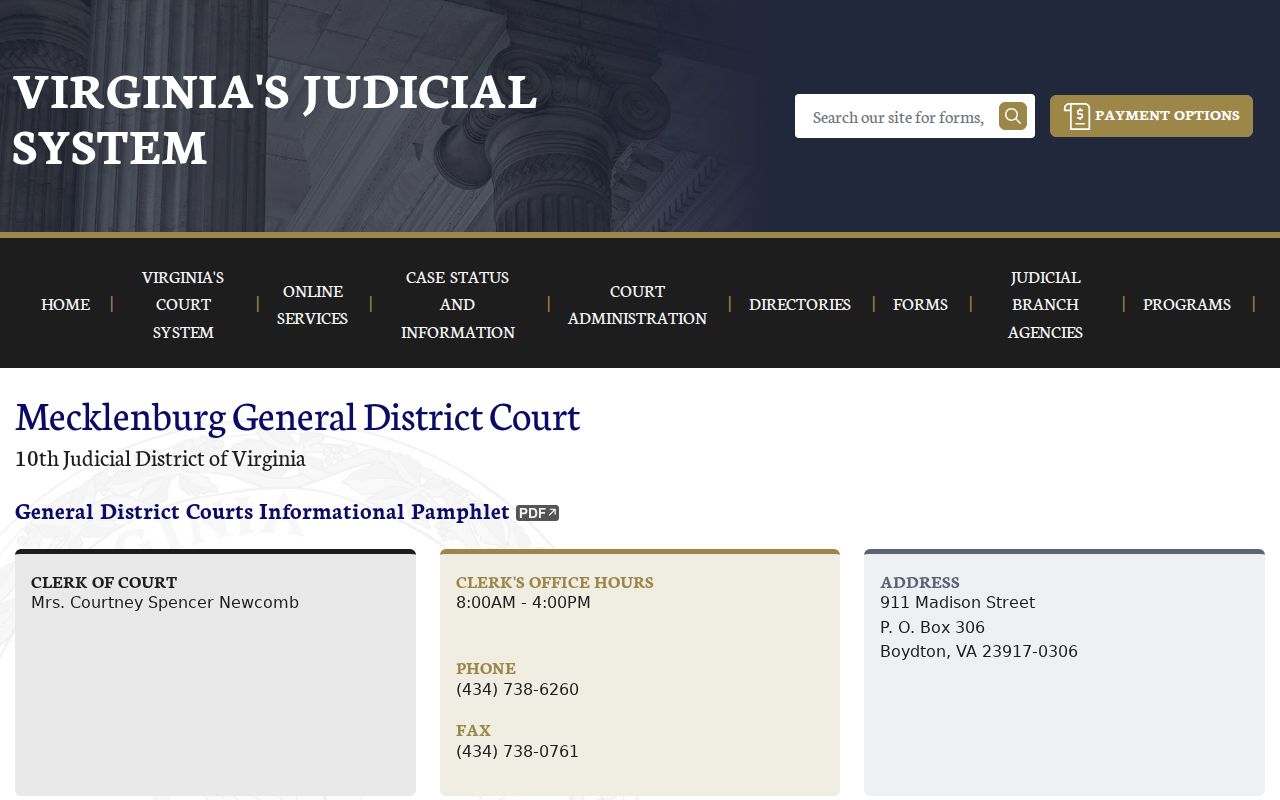
Town cases commonly occupy the Monday settings, but the live court page should be checked because schedules can change. The official pages also give slightly different counter hours. Call before a trip rather than relying on one copied schedule.
Criminal Case Stages in Mecklenburg County
A criminal matter may begin with an arrest or summons, followed by a complaint or warrant and a prompt magistrate review when required. General District Court advises the accused and conducts a felony preliminary hearing. A finding of probable cause can certify a felony to Circuit Court, while a grand jury can indict it. Circuit proceedings may then include arraignment, motions, discovery, plea talks, a bench or jury trial, disposition, and sentence.
Case flow: Charges Filed › Arraignment › Pretrial › Plea or Trial › Disposition › Sentencing
An appeal or post-judgment motion can add later entries. The path is not identical in every case. A dismissal and nolle prosequi are not convictions; an acquittal is a not-guilty merits outcome. Certification shows that a felony moved from GDC toward Circuit, not that guilt was decided.
Reading Mecklenburg County Case Outcomes
Plain terms prevent common mistakes in Mecklenburg County case research. A case-level status may hide different results on separate counts, and a future hearing date is not an outcome. Read the plea beside the judgment and disposition, then check sentence fields and later events.
- Certification
- A General District Court step sending a felony onward to Circuit Court after preliminary proceedings.
- Nolle prosequi
- The Commonwealth stops prosecuting that charge at that time; it is not a conviction.
- Dismissal
- The charge ended without a conviction, though the reason and later history may require the file.
- Acquittal
- A not-guilty result after the merits were decided.
- Disposition
- The result entered for a specific charge.
Note: A Mecklenburg County hearing date is a scheduled event and may move if the court grants a continuance.
Older Mecklenburg County Court Files
Online case systems do not promise every older file or its supporting documents. Virginia Code §17.1-213 sets retention context, including long retention for convictions of sexually violent offenses, violent felonies, and acts of violence. Other ended files may follow conversion, microfilm, and destruction schedules. The clerk is the practical route for a contemporary certified judgment, while historic research may lead to microfilm and archival holdings.
The official case-finding image below comes from the Judiciary's self-help explanation of court searches.
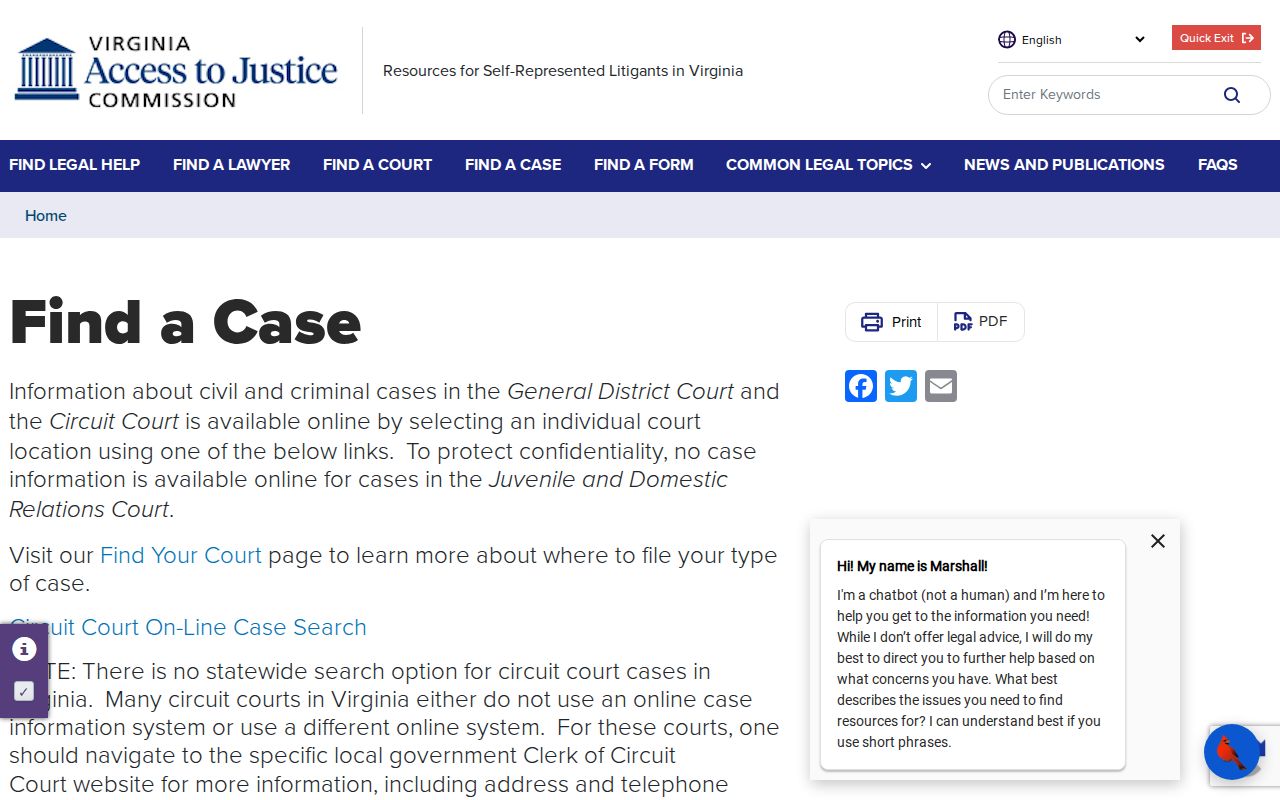
Mecklenburg County's history adds a special limit: Library of Virginia research notes that many loose records from before 1783 are missing. A gap in an early record trail can reflect loss or retention history, not a modern access denial.
Access Rules for Case Records
Nonconfidential Circuit clerk records are open for inspection and copies under Virginia Code §17.1-208, subject to reasonable fees. Remote access may be offered while confidential data remains protected under §17.1-225. Court files are not ordinary county-agency FOIA records. Send a Circuit pleading or judgment request to the Circuit clerk, and a misdemeanor or preliminary-hearing file request to the General District clerk.
A blank online result does not prove that no case exists. Check spelling, search the right court, and ask the clerk about older or nonpublic material. The clerk can explain available inspection and copy routes but cannot release a record barred by law.